If your Maui plans include exploring different parts of the island, a rental car is usually the most practical starting point. If you mainly want beach time near your accommodation, with one organized outing, compare a few rental days with a stay that uses transfers and local transport.
The useful question is which days actually need a car? Put your accommodation, meals, and two or three priorities on a map before reserving a vehicle for the whole stay. A car sitting in a paid parking space may add little to a pool day; collecting and returning a short rental can take a sizeable piece of an outing day.
Official bus rules, fares, and transport information checked October 21, 2026. Recheck schedules, service notices, rental terms, and pickup arrangements for your dates.
Start with your Maui base
Use the official Maui regions overview to orient yourself, then look closely at your accommodation’s address. These are planning suggestions; an area name alone does not establish that a property has safe walking routes or convenient bus stops.
| Your base and plans | A useful starting choice | Check before committing |
|---|---|---|
| Kīhei or Wailea, mostly staying nearby | Compare selected rental days with no rental. | The actual walk to food, groceries, the shore, and any tour pickup. |
| South Maui with several island outings | Compare a full-stay rental with a single block of driving days. | Parking charges and the time needed to collect a short rental. |
| Kāʻanapali, mostly enjoying the local coast | A stay without a car may work with planned airport transfers. | Walking access from your property and transport for anything beyond that area. |
| Nāpili or Kapalua, with frequent outings | A rental becomes more useful as your plans spread out. | Food, beach access, and the journey to each booked activity. |
| Upcountry or a remote base | Plan a rental or specifically arranged transport. | Daily meal trips, grocery access, and dependable return journeys. |
Our Maui accommodation guide compares those areas in more detail. If a property costs less but requires extra paid rides every day, include that difference in the accommodation decision.
Three ways to arrange the trip
Keep a car for the full stay
This is worth pricing when you expect several independent outings, are changing bases, or want flexibility around meals and family routines. You collect the vehicle once and keep it through departure. That can also simplify carrying groceries, mobility equipment, or the group’s beach supplies, provided the vehicle actually fits them.
The tradeoff is paying for days when you barely use it. Ask the property for its current parking charge, taxes, and any valet requirement. Do not assume parking is included in a resort fee.
Rent for selected days
A short rental suits a trip with a clear driving portion and several local days. Cluster nearby stops on each outing, while keeping long drives on separate days. Our seven-day Maui itinerary helps show which days could stay close to your base.
Price the collection and return journeys as well as the rental. A nearby office may save time; an airport booking may require another round trip to Kahului. Check the exact branch address, opening hours, and after-hours procedure. Do not assume a vehicle advertised for “Maui” is waiting near your hotel.
For an early Haleakalā visit, confirm whether you need to collect the car the afternoon before. For sunset, check whether your return falls outside staffed hours or adds another rental period. Use the actual pickup and drop-off times in the quote.
Stay without a rental car
This works best when you deliberately choose a small area for most of the trip and arrange the exceptions. Check airport transfers in both directions, everyday meals, and any tour’s pickup point before booking the accommodation.
Write down how you will return from every outing. An available outbound taxi or rideshare does not establish that a driver will be available later at a remote beach, trailhead, or park. If the return is uncertain, choose another transport arrangement or change the outing.
What Maui Bus can realistically cover
Maui Bus can be useful when your origin, destination, and timing fit an actual route. Start with the county’s route maps and trip-planning links. Check the walking portions, transfers, and return service, not just whether two places appear on the island map.
The July 2026 county timetable lists a general fare of $2 per boarding and a $4 fixed-route daily pass. Transfer tickets are not issued. Check the current fare-free categories if relevant to your group, and have the required fare or pass ready.
For airport journeys, Routes 35, Haiku Islander, and 40, Upcountry Islander serve Kahului Airport. That does not make them direct services to every hotel. Work through your complete trip using the airport’s bus information and current county timetable, allowing for luggage collection and any connection.
Check your bags before choosing the airport bus. The county baggage rules allow one standard carry-on-sized suitcase, duffel, or backpack no larger than 22 × 14 × 9 inches. Items must fit under your seat or on your lap without blocking an aisle, occupying another seat, or interfering with other passengers. The rules separately cover strollers and other items; read those if they apply. A large checked suitcase is not a workable assumption for this service.
There is also a clear limit for park trips: NPS says public transport does not reach either district of Haleakalā National Park. The Upcountry route name does not mean it takes you to the summit. For that outing, arrange a vehicle or an authorized tour and use our Haleakalā planning guide.
Make arrival and departure part of the comparison
For an airport rental, read the provider’s collection instructions before flying. Kahului has a consolidated rental facility connected to the terminal by a tram, described by Hawaiʻi’s Department of Transportation. Confirm where your particular booking is collected and follow current airport signs; do not assume every company uses identical arrangements.
If you are booking transfers instead, get a quote for your full party and luggage. Ask how flight delays, child seats, accessibility needs, and the return pickup are handled. A per-person transfer and a vehicle-priced transfer need different calculations.
On departure day, allow for returning the car, any fuel or charging requirement, and reaching the terminal. With a partial rental, check whether airport return is permitted and whether a different return location adds a charge. Keep the flight connection comfortable rather than relying on the shortest journey estimate.
Compare the complete cost
Use the same dates, passengers, bags, and outings for each option. Record complete quotes in our trip budget planner. This framework has no assumed rental prices:
| Option | Add these amounts |
|---|---|
| Full-stay rental | Complete rental quote + accommodation parking + fuel or charging + outing parking + any other rides you still need. |
| Selected rental days | Short-rental quote + collection/return transport + parking and fuel for those days + airport transfers and local transport outside the rental period. |
| No rental | Both airport transfers + planned local rides or bus fares + transport included in or added to organized outings. |
Ask what the rental quote already includes before adding taxes, fees, optional coverage, extra drivers, or child seats again. Note refundable deposits or card holds separately from the trip’s final cost. For a tour, compare the whole outing consistently; do not treat a ticket that includes guiding and admission as a pure transport charge.
Then write down the time required. If dropping several rental days saves little after transfers, keeping the car may be worthwhile. If the car would sit unused for most of the visit, a simpler local plan may cost less and involve fewer driving days. Let your actual quotes decide.
Choose fewer drives you can comfortably manage
A rental gives you flexibility, but it does not make every mapped road suitable or permitted under your contract. Check the planned route, current access, and rental restrictions before setting off. For East Maui, read our Road to Hāna planning guide before arranging the driving day.
For an electric vehicle, confirm usable charging arrangements at your base and sufficient range for the outing; NPS lists no charging stations inside Haleakalā. Whichever vehicle you choose, group nearby stops, respect closures and legal parking, and keep a day near your accommodation. Our Maui travel guide can help build that balance.
Use transport as part of the Maui plan
Compare the transport choice with the Maui base guide, complete trip budget, and seven-day itinerary. If the car is mainly for East Maui, read the Road to Hāna guide before choosing the rental dates.
Official sources to recheck
Use Maui County’s bus information, its service updates, Kahului Airport’s rental directory, and NPS driving information. Your accommodation and transport provider should confirm the property-specific and booking-specific details.
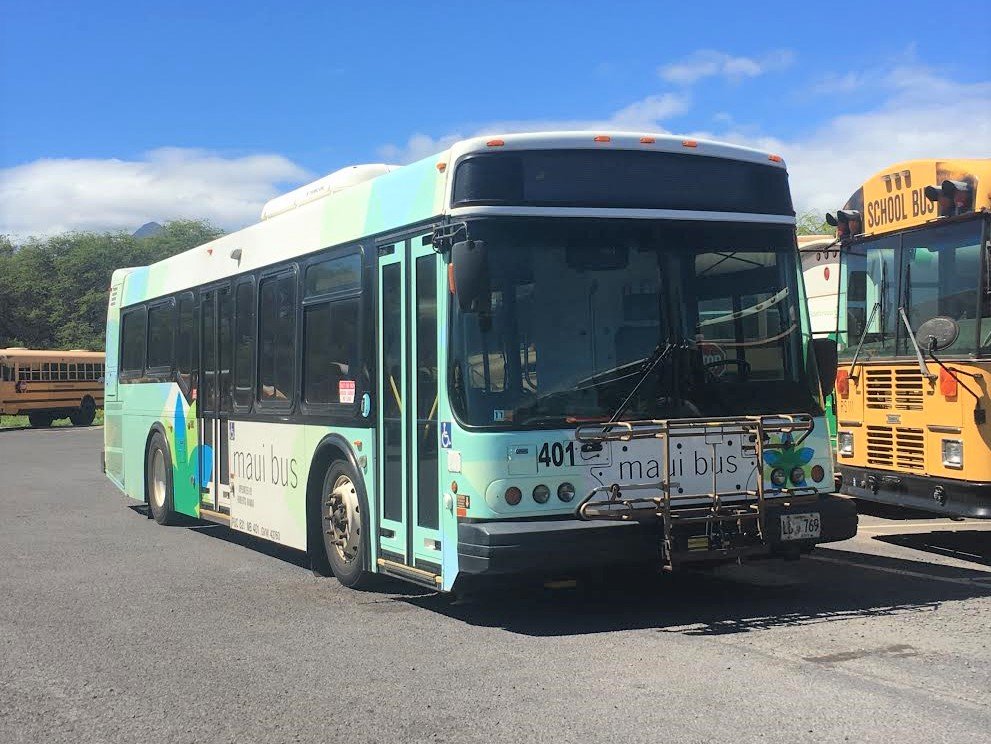
Featured photograph: Maui Bus 401, photographed February 18, 2020. Thomasw5737 / Wikimedia Commons, CC BY-SA 4.0. Resized and cropped for display; image adaptations retain the same license.
