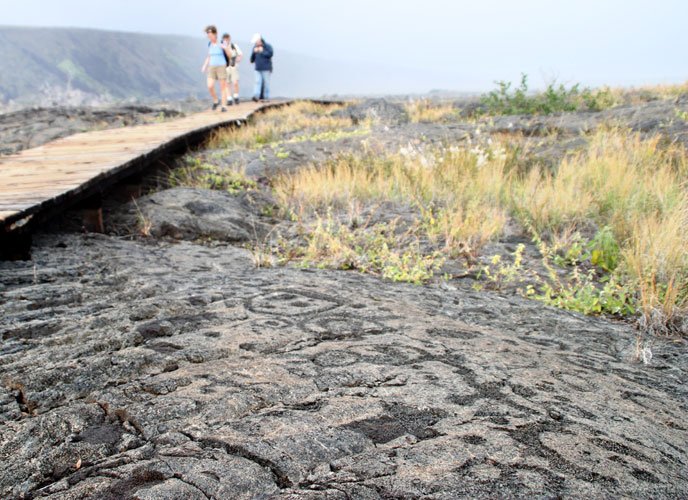
If you have time for just one walk on the lower portion of Chain of Craters Road, Puʻuloa provides something the roadside lookouts cannot: a chance to encounter a Native Hawaiian cultural landscape on its own terms. The destination is a protective boardwalk over an extensive field of kiʻi pōhaku, or rock carvings. This is not a place to climb over the carvings for a photograph. The way you walk matters as much as the view.
The National Park Service describes Puʻuloa as a sacred site with approximately 23,000 petroglyphs and a 1.4-mile round-trip trail from the Puʻuloa parking area on Chain of Craters Road. Allow about 1 to 1½ hours—more if you prefer to walk slowly over uneven lava. Read the park’s trail description.
Where to park and how to find the start
Drive down Chain of Craters Road from the Kīlauea summit area and use the signed Puʻuloa trail parking area. It is not a walk from the main visitor-center complex. If your day includes the coast and the Hōlei Sea Arch area, schedule the trail as a distinct stop on the same road; do not assume you will find shade, refreshments or water at the trailhead.
The walk crosses an older hardened lava flow. Even when it looks relatively level from the parking area, the surface can be fractured, irregular and sharp. Bring a full water bottle, covered shoes with reliable traction, sun protection and a light rain layer. Avoid fitting the walk in at the very end of daylight: finding your way back over lava in poor visibility is unnecessarily risky.
What you will see at the boardwalk
The protected viewing area reveals carvings of many different forms. Some circular depressions have cultural associations with the piko, or umbilical cord, of newborn children; the NPS interpretation explains the connection with family, ancestors and wishes for long life. Resist the urge to reduce the whole site to a count of figures or treat individual carvings as puzzles for visitors to decode. Interpretation belongs in the broader context of generations of Hawaiian use.
Photograph from the boardwalk. Do not reach across barriers or step onto marked rock panels. Even seemingly gentle foot traffic can permanently damage the surface. Do not stack stones or create your own trail markers. The park warns that moving rocks can harm both navigation and cultural meaning.
Is this hike appropriate for children or limited mobility?
The distance may sound family-friendly, but the surface is more demanding than a paved walkway. Some children who happily manage a mile on a sidewalk may struggle with sharp lava, heat, or the absence of shade. Adults should help younger hikers place their feet and keep everyone together. For a stroller or wheelchair user, this is not equivalent to the park’s paved Devastation Trail: NPS describes Puʻuloa as moderate and traversing uneven solidified lava.
If the group needs a shorter, smoother outing, consider Nāhuku lava tube or a confirmed accessible overlook instead. Make the substitute plan before starting down the road, not after someone becomes tired on the exposed trail.
A low-pressure Chain of Craters Road plan
The practical approach is to make Puʻuloa your principal walking stop rather than squeezing in every viewpoint. Start the descent early, stop at the overlooks that interest you, park at the signed trailhead, walk to the boardwalk and return with a comfortable daylight margin. Finish the road only if everyone still has energy. There is no need to race back to the summit for another long hike.
Pair this route with our Chain of Craters Road driving guide. If you have just one day in the park, our Hawaiʻi Volcanoes National Park itinerary helps decide whether this coastal detour fits your time.
Check conditions and leave the place intact
Volcanic activity, weather and emergency response can temporarily change access. Use the NPS’s current conditions before driving down. Never enter a closed area to see a carving, take a closer photo or shorten your return route.
Sources and review: Reviewed November 2, 2026 against the National Park Service Puʻuloa trail page and Hawaiʻi Volcanoes day hikes. Featured photograph: National Park Service, public domain.