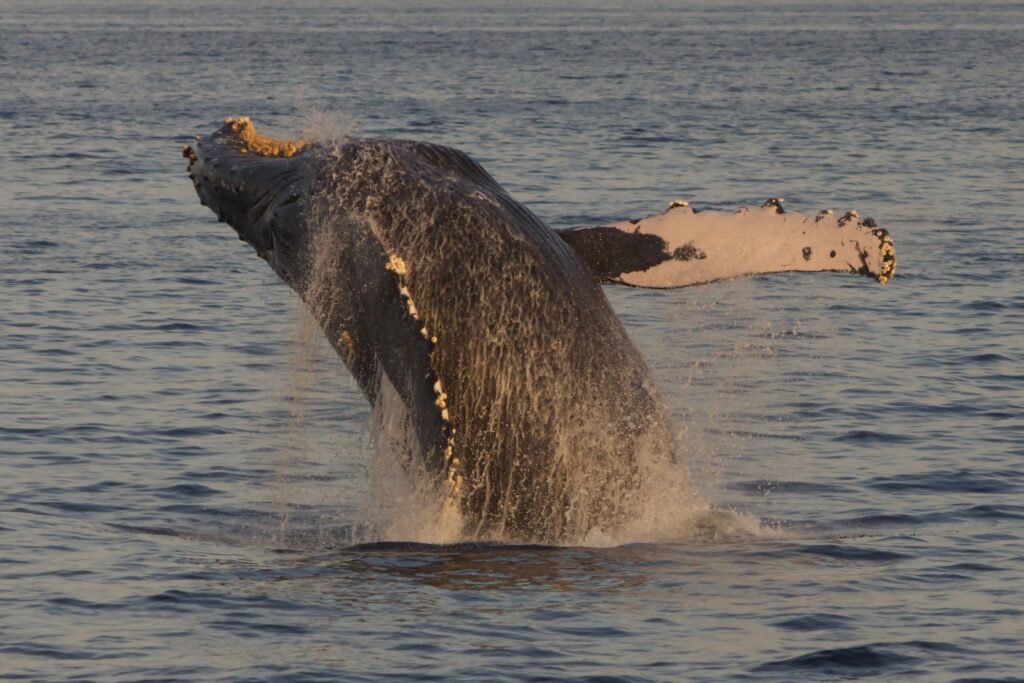
Maui is one of Hawaiʻi’s best-known places for humpback-whale viewing, but a good trip starts with realistic expectations. Whales are wild, federal distance rules apply, and the “best” boat depends on whether you care most about ride comfort, group size, photography, interpretation, or accessible boarding.
Choose the vessel and departure logistics first. Let whale behavior be the part you cannot schedule.
When to plan Maui whale watching
Humpbacks begin returning to Hawaiʻi around November and some remain into May. NOAA materials identify the middle of winter—roughly January through March, with February and March often cited as a peak—as the period of greatest abundance.
That does not create a sightings guarantee. If whales are the only reason for the trip, understand that wildlife can make any individual departure quiet.
The boat must stay 100 yards away
Federal law prohibits approaching humpback whales within 100 yards in Hawaiʻi. The sanctuary also promotes slower vessel operation around whales. A captain who respects the distance is doing the job correctly, even when passengers want a closer photograph.
If a whale surfaces closer on its own, vessel operators follow specific procedures rather than maneuvering to maintain the close encounter.
Large boat or small boat?
| Vessel style | Potential advantages | Questions to ask |
|---|---|---|
| Larger catamaran / vessel | More deck space, shade, restrooms, steadier ride for some travelers | Passenger count, boarding method, upper-deck stairs, seating |
| Smaller raft / rigid inflatable | Fewer guests, low viewing angle, fast repositioning | Ride impact, shade, restroom, age/health restrictions, boarding ladder |
| Sailing vessel | Quieter style and more relaxed outing when conditions allow | How much time is under sail, passenger count, boarding and restroom details |
Departure point can matter more than a small fare difference
Operators depart from different Maui harbors and coastal loading points. Confirm the exact location before paying. Add the drive from your hotel, parking, check-in time, and the return trip to the ticket price.
Do not assume a West Maui address means a Lahaina Harbor departure or that every operator uses the same facility. Recovery and harbor operations can change; follow the operator’s current confirmation.
Ask what happens if the trip is quiet
Some companies offer a repeat trip when no whales are seen; others do not. Read the exact definition and whether the return must occur during your stay. A “free second trip” is not useful if there is no space before your flight home.
Interpretation is part of what you are buying
A naturalist, hydrophone when appropriate, research partnership, or thoughtful captain can turn distant sightings into a better experience. Ask who interprets behavior and whether the operator participates in conservation, research, or reporting rather than relying on a generic “eco tour” label.
Our Hawaiʻi ecotourism guide explains how to evaluate those claims.
Shore viewing may be enough for your group
If someone is prone to seasickness, dislikes boats, or needs a fully flexible outing, shore viewing can be the better choice. Bring binoculars and use legal coastal viewpoints. Our broader Hawaiʻi whale guide compares shore and boat viewing.
Accessibility and motion deserve specific questions
- Is boarding from a dock, beach, ladder, or steps?
- Can a wheelchair or mobility device remain aboard safely?
- Are restrooms on the same level as seating?
- How much shade is available?
- What are the operator’s pregnancy, back/neck, age, or mobility restrictions?
- Can a guest remain seated and still see reasonably well?
Where it fits in a Maui itinerary
Treat whale watching as a half-day anchor, not an add-on before the Road to Hāna. Pair it with a nearby meal and a relaxed afternoon. Use the Maui itinerary, transport guide, and budget guide to choose the date and complete cost.
Sources and review
Reviewed October 24, 2026 using NOAA Fisheries and Hawaiian Islands Humpback Whale National Marine Sanctuary guidance. Humpback presence varies within the season; federal 100-yard approach requirements apply throughout Hawaiʻi.
Featured photograph: female humpback whale breaching off Maui, February 13, 2014. Jkrauska / Wikimedia Commons, CC BY-SA 3.0.