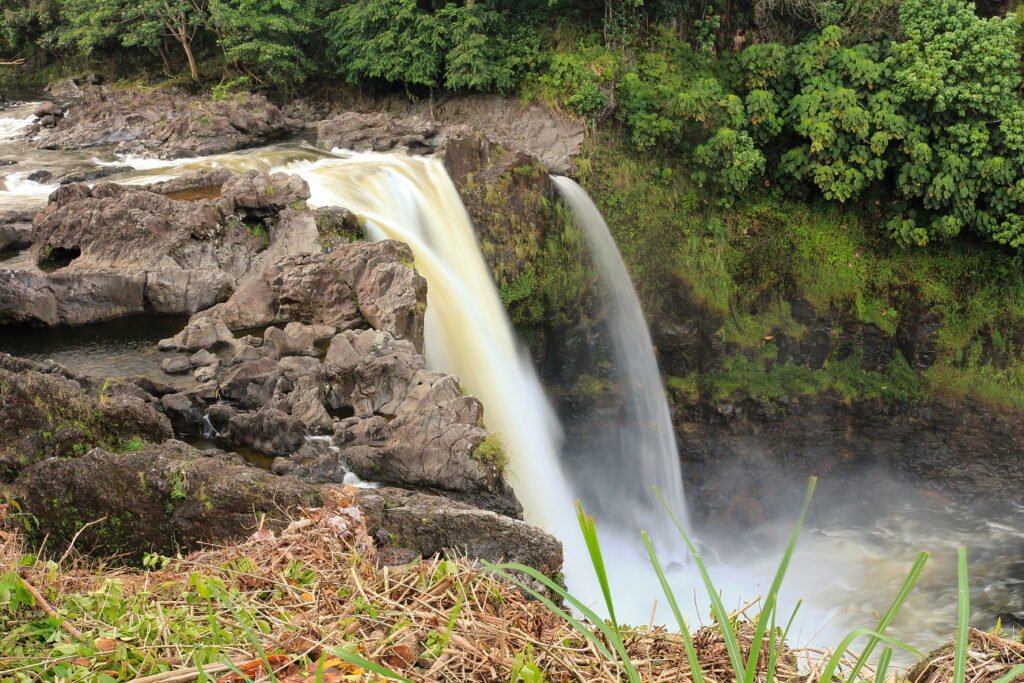
Rainbow Falls and Boiling Pots are two sections of Wailuku River State Park just outside downtown Hilo. They are easy to combine in one short outing, but the river’s power is easy to underestimate.
The safest plan is simple: treat both as viewing stops, not swimming holes. There are no lifeguards, and Hawaiʻi tourism guidance says neither area is safe for swimming.
One current fee covers both park sections
Check before visiting: The official Wailuku River State Park page has the current fees, hours, and access details. Rainbow Falls and Boiling Pots have separate parking areas, although one park payment covers both sections.
Since January 2026, the same Wailuku River State Park entry and parking payment is valid for both Rainbow Falls and Boiling Pots. You do not need to pay a second state-park admission when moving between the two sections during the same visit.
| Plan for | Current information |
|---|---|
| Hours | Daily 7 a.m.–5:30 p.m. |
| Gate closure | 6 p.m. |
| Nonresident entry | $5 per person |
| Children age 3 and under | Free |
| Nonresident parking | $10 per private vehicle |
| Payment | Credit card |
Rainbow Falls is an 80-foot waterfall
Rainbow Falls drops about 80 feet over a lava cave into the Wailuku River. The main overlook is close to parking, making this one of the easier major waterfalls to view on Hawaiʻi Island.
Sun and mist can sometimes produce a rainbow, but do not time the entire day around a guaranteed photograph. The waterfall is worthwhile without one.
Boiling Pots is about river geology, not water entry
Upstream at Boiling Pots, water moves through a series of pools and cascades carved into basalt. During higher flow the pools can appear to churn or “boil,” which gives the area its name.
That movement is exactly why the site should not be treated like a calm natural swimming pool. Fast current, slippery rock, changing water level, and hidden hydraulics can become dangerous quickly.
Do not swim or climb down to the river
GoHawaii explicitly notes that neither Rainbow Falls nor Boiling Pots is safe for swimming and that neither location has lifeguards. Stay in designated viewing areas and follow barriers and posted warnings.
Heavy rain can raise the Wailuku River even when the immediate viewpoint does not look stormy. Our Hawaiʻi rain and flash-flood guide explains why upstream weather matters.
How much time should you allow?
A focused visit to both sites can fit into roughly an hour, but give yourself more time if parking is busy, you move slowly, or you want to combine the stops with Hilo dining, museums, or another east-side attraction.
Pair it with Hilo, not a rushed cross-island checklist
Wailuku River State Park is close to Hilo, so it fits naturally with a Hilo-based morning, farmers market day, museum stop, or Hawaiʻi Tropical Bioreserve & Garden visit.
A simple two-stop plan
- Check the state park page and local weather.
- Pay the current nonresident park and parking fee.
- View Rainbow Falls from the designated overlook.
- Drive to the Boiling Pots section using legal parking.
- Stay out of the river and off closed rock areas.
- Leave before the gate closure and continue your Hilo day.
Rainbow Falls works well for mixed-ability groups
The primary Rainbow Falls viewpoint is much easier to reach than a long waterfall hike, which can make it useful for families and multigenerational groups. That does not mean every optional stair or secondary viewpoint will suit every visitor. Let the least mobile person enjoy the main overlook without making an extra climb a requirement.
Rain changes the river faster than it changes your schedule
Hilo’s rain is part of what feeds this landscape. After heavy rainfall, the waterfall can become more powerful and the river more dangerous. Keep children well back from edges and barriers, and never use higher flow as a reason to move closer to the river for a photograph.
What to bring for a short stop
- Rain layer or umbrella for passing showers
- Secure shoes for wet pavement or steps
- Water if you are continuing a longer Hilo day
- A card for current nonresident fees
- A flexible next stop in case heavy rain reduces visibility
Sources and review
Reviewed October 26, 2026 using Hawaiʻi DLNR State Parks and Hawaiʻi Tourism Authority Wailuku River State Park guidance. Fees, hours, river flow, and weather conditions can change.
Featured photograph: Rainbow Falls, Hilo, photographed in 2014. Robert Linsdell / Wikimedia Commons, CC BY 2.0. Cropped for display.