For a first Oʻahu trip with a mix of beach time, restaurants, and sightseeing, Waikīkī is our starting recommendation. Choose Ko Olina when the resort is a major part of the holiday. Choose the North Shore when you want to spend several days in that part of the island, rather than visit once and drive back.
The right base depends on what an ordinary day will look like. A beautiful room is less useful if every breakfast, outing, and evening meal requires a journey you did not budget for. Before comparing hotels, mark your three most important activities on a map and read our Hawaiʻi trip-planning starting guide.
Which Oʻahu base fits your trip?
| Base | Best fit | Transport approach | Main tradeoff |
|---|---|---|---|
| Waikīkī | A first visit with varied activities and places to eat | Walking, buses, booked transfers, and selected rental-car days | You are staying in a busy visitor district |
| Ko Olina | Several days enjoying your accommodation and nearby lagoons | Airport transfers plus planned outings, or a car if exploring frequently | Cross-island sightseeing can compete with the resort time you paid for |
| North Shore | Multiple days around Haleʻiwa, the surf coast, and the island’s north | A car or carefully arranged transport for a varied itinerary | The exact accommodation address matters more than the regional label |
These are planning recommendations, not a ranking of which coast is “best.” If your group wants different things, choose the base that makes the most repeated journeys easy.
Waikīkī: the most flexible starting point
Waikīkī is Oʻahu’s principal hotel and resort area. Its shopping, dining, and entertainment are concentrated around streets including Kalākaua and Kūhiō avenues, as described in the official Go Hawaiʻi Waikīkī guide. That concentration is useful when you want to leave the room and find something to do without organizing a full excursion.
For a week with a few sightseeing days and several slower days, start by pricing a hotel here without a car for the entire stay. You can then add transport around the activities you actually choose. Our Oʻahu rental-car guide explains how to compare that approach with keeping a vehicle all week.
The particular block still matters. Check the walking route from the hotel entrance to your preferred beach access, breakfast options, and bus stop. A straight-line distance on a booking map does not show crossings or the entrance you will use with luggage. If sleep is a priority, ask about the room’s position relative to roads, entertainment venues, elevators, and construction before choosing a rate.
Ko Olina: choose it for the days you will spend there
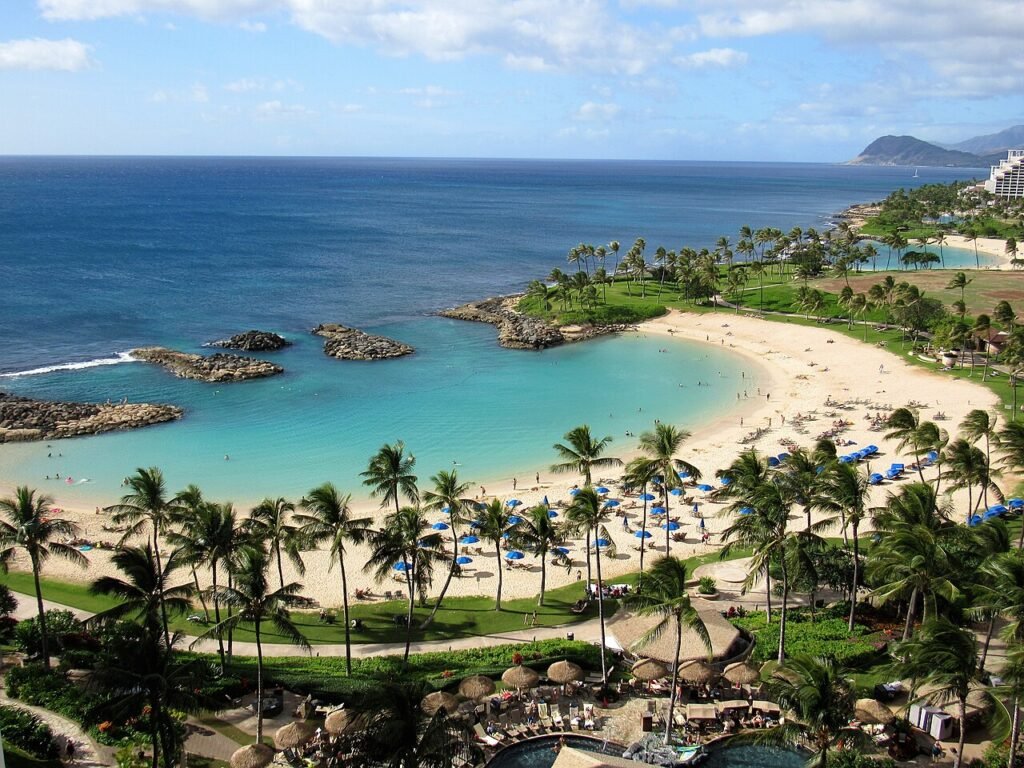
Ko Olina brings resorts, dining areas, a marina, and lagoons together on Oʻahu’s west side. Use the official resort map to see where a specific property sits relative to those facilities. Two accommodations described as being “in Ko Olina” may give you different walks to meals or the shoreline.
This is our preferred choice when the itinerary intentionally leaves room for the property: breakfast without rushing, time by the pool, and a short walk before dinner. Before booking, compare the actual facilities included with your room. Access to one resort’s pools, activities, or other amenities should be confirmed with that property; a nearby accommodation is not a substitute for that confirmation.
The four lagoons are linked by seaside paths. Ko Olina’s current lagoon information says there are no lifeguards on duty and that designated public parking is available from sunrise to sunset on a first-come, first-served basis. A lagoon setting does not remove the need to assess conditions and supervise children.
Reconsider this base if you have already planned an early departure for a different coast almost every day. You may be paying for amenities you barely use. Put those journeys into your itinerary first, including the return to the hotel, and decide whether they still leave enough time for the stay you pictured.
North Shore: a good base when the north is your destination
Think of the North Shore as a region, not a single hotel neighborhood. Haleʻiwa, the well-known surf beaches, and the Turtle Bay–Kahuku area are distinct places along the coast. The official North Shore guide is a useful orientation before you compare addresses.
A northern base makes sense when several of your priority activities are nearby and you want unhurried time between them. It makes less sense when your wish list is mainly in Honolulu and the southeast. For each accommodation, locate breakfast, dinner, and your planned activity meeting points. Decide how you will reach them after dark, too.
Season also changes the kind of beach holiday to expect. Go Hawaiʻi describes the North Shore’s large winter surf; summer often brings smaller waves, but a calendar is not a swimming assessment. Honolulu Emergency Services advises checking conditions, talking to lifeguards, and choosing a lifeguarded beach. Book this base for the area you want to explore, not a promise that the water outside your room will be suitable every day.
Compare the cost of the whole stay
Use the same dates, number of guests, and cancellation terms when comparing properties. Save the final booking breakdown rather than the first nightly price displayed. Then add the costs your location creates.
| Cost to check | Question to answer before booking |
|---|---|
| Room and mandatory charges | What is the complete total for these guests and dates, including taxes and required fees? |
| Parking and transport | How many rental days, parking nights, and paid transfers will this base require? |
| Meals | Which realistic breakfast and dinner options are within the distance you want to travel? |
| Useful amenities | Will a kitchen, laundry access, breakfast inclusion, or a larger room save money or effort? |
| Flexibility | What can be changed or cancelled, and when does that option end? |
A higher room price can still produce a lower trip total if it eliminates enough transfers or rental days. The reverse can happen when a cheaper room adds daily travel. Work through the same categories in our Oʻahu trip-budget guide.
Check access for the people actually traveling
“Walkable” is a personal requirement. Heat, fatigue, a stroller, luggage, or a mobility device can change what feels convenient. Ask the accommodation specific questions and request written confirmation of essential features.
- Is there a step-free route from the drop-off point to the room and the facilities you intend to use?
- Does the exact room category provide the bathroom layout, bed clearance, or connecting-room arrangement you need?
- What is the usable route to the beach, and does it involve steps or crossing sand?
- Can your group comfortably reach meals without another paid journey?
Should you split the stay?
For a short first visit, one base keeps the logistics simpler. For a longer stay with a clear Honolulu portion and a separate northern or resort portion, one hotel change can be worthwhile. Make each stop long enough to enjoy it: packing, checking out, storing bags, and checking in use part of a day.
Try the plan on paper before reserving both rooms. If the move exists only to tick off another area, visit that area on an outing instead. If it replaces several repeated journeys and gives you time there, it has a clearer purpose.
Turn the choice into a workable itinerary
Shortlist one base, two or three accommodations, and the transport pattern each would require. Then place your priorities into our seven-day Oʻahu itinerary. Use the Oʻahu guide hub and where-to-stay resources to continue planning, and keep the final addresses and costs with your trip-planning downloads.
Official location, transport, and access information checked October 18, 2026. Recheck property details and operating conditions for your travel dates.
Featured photograph: Ko Olina Lagoon 3, Oʻahu (2020). Farragutful / Wikimedia Commons, CC BY-SA 4.0. Resized for the web; image display crops retain the same license.

Plan local outings from your chosen base
If you stay in Waikīkī or Honolulu, the new Honolulu Museum of Art, Bishop Museum, and ʻIolani Palace guides help build low-driving cultural days. For the southeast, compare Koko Crater with Makapuʻu before assuming the steeper hike is the better use of a morning.
If your stay is closer to the windward side, use the Hoʻomaluhia Botanical Garden and Kailua versus Lanikai guides to plan around parking, facilities and neighborhood pressure. For a North Shore base, Waimea Valley and the North Shore route guide are natural next reads. For a more remote coastal walk, check the Kaʻena Point access and wildlife guide before making plans: storm-related trail and vehicle-access closures were still in effect in early November 2026.