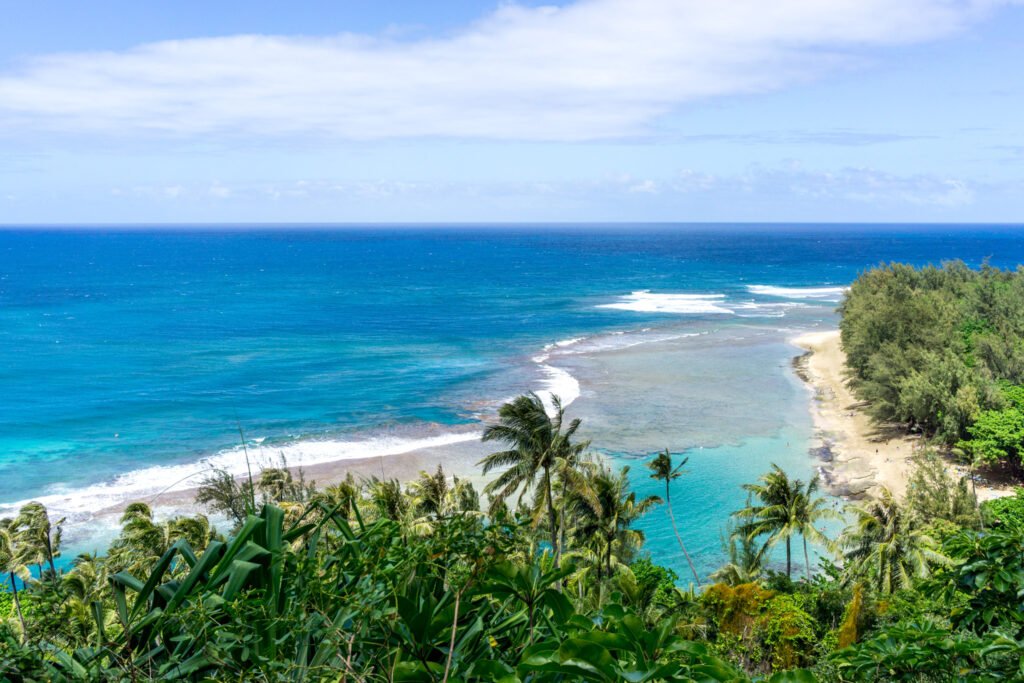
A Hāʻena reservation is easier to get right when you decide how you will arrive before choosing a hike. Driving, riding the shuttle, and being dropped off require different arrangements. The park reservation also has limits: it does not give you permission to walk the entire Kalalau Trail.
Access checked October 21, 2026: Hāʻena State Park reopened on October 15, including day hikes to Hanakāpīʻai Beach and Falls. Overnight camping and hiking beyond the two-mile point on the coastal Kalalau Trail remain closed until further notice. Read the DLNR reopening notice and check current park conditions before setting out. A reservation does not override a closure.
Choose the reservation that matches your transport
For nonresident visitors, the main choices are below. State Parks directs visitors to Go Hāʻena, its reservation partner. A regular day visit and an overnight Kalalau trip are separate planning tasks.
| How you will arrive | What to book | What to check |
|---|---|---|
| Your own rental car | Parking plus entry for your party | Your reserved parking window covers the whole visit, including the walk back. |
| North Shore shuttle | Shuttle plus park entry | The departure stop, check-in instructions, and return arrangements. |
| A permitted drop-off or another arrangement without parking | Entry-only reservation | A confirmed way back. This option does not solve transport for you. |
State Parks’ access guidance says nonresidents driving in need both parking and admission; longer visits require additional parking slots. Hawaiʻi residents with accepted identification have separate entry arrangements. Read the current identification rules for mixed resident and visitor groups.
Entry-only should be a deliberate choice. Do not build a day around being able to find a return ride after a tiring hike. Likewise, do not treat a shuttle reservation as a substitute parking pass: you must arrive on the shuttle to use its included park entry.
Book the date, then build the day around it
Go Hāʻena releases dates 30 days ahead at midnight Hawaiʻi Standard Time. Set a reminder in Hawaiʻi time so your home time zone does not put you a day early or late. Parking can disappear quickly; having several possible dates gives you more room to work.
- Choose your outing first. A beach visit, the hike to Hanakāpīʻai, and the waterfall extension need different amounts of time and energy.
- Read the access and weather notices. Check that the activity you want is available before purchasing transport.
- Select the appropriate arrival option. Compare the complete party cost and the amount of usable time, rather than choosing only by the lowest headline price.
- Check names, date, stop, and time before paying. The operator checks adult identification and prohibits transferring reservations to other people.
- Save the confirmation offline. Put the reservation, return instructions, and a simple day plan somewhere you can access without a signal.
Do not book an afternoon parking window for an ambitious hike and hope to make the timing work later. Work backward from the time you must be back, allow a generous margin, and choose a shorter outing if the available reservation does not fit.
What does it cost?
When checked on October 21, the operator’s FAQ listed shuttle fares including entry of $45 for ages 16 and older, $25 for ages 4–15, and free travel on a lap for ages 0–3. It listed parking at $20 per vehicle per timeslot, plus $5 entry per person.
Parking prices conflict across official pages: the October 13 DLNR release still lists $10 per vehicle. Confirm the current charge, child admission rules, and any additional charges in the live booking checkout; use the confirmed total in your budget. We have not treated either parking figure as a guaranteed quote.
Know which walk you are choosing
The State Parks distance guide separates the beach and waterfall routes. The distances below are from the trailhead; reaching the trailhead from the main parking or shuttle area adds walking.
| Outing | Distance | Planning decision |
|---|---|---|
| Kēʻē Beach area | No Kalalau hike required | Choose this when you want a less ambitious park visit; check access needs and ocean conditions separately. |
| Hanakāpīʻai Beach | About 2 miles each way; 4 miles round trip | A demanding hike with steep, uneven ground. Reaching a beach does not make this a swimming outing. |
| Hanakāpīʻai Falls | About 4 miles each way; 8 miles round trip | A much longer outing for experienced hikers, with stream crossings and added weather exposure. |
| Beyond Hanakāpīʻai along the coastal trail | Outside this day-visit plan | Currently closed. When open, a valid camping permit is required even to proceed beyond the valley on a day hike. |
The official Kalalau Trail page recommends the falls route for experienced hikers and warns against swimming at Hanakāpīʻai Beach. The full trail reaches Kalalau Valley 11 miles from the trailhead. Do not confuse Hanakāpīʻai, reached on the shorter outing, with Kalalau at the far end.
A turnaround before your planned destination can still make a worthwhile day. Decide as a group that deteriorating conditions, fatigue, or running short of time are enough reason to return. A booking fee is not a reason to keep going.
A workable day leaves time to get back
For a first visit, choose one main activity and keep dinner plans flexible. Here is a suggested sequence, not a timed promise:
- Before leaving: check the forecast, park notices, and road conditions; eat and pack before you start the drive.
- At arrival: confirm the return arrangements, use the facilities, and agree on your turnaround time.
- During the outing: keep the plan within the ability of the least confident person in your group. Include breaks in your time allowance.
- Before departure: leave enough time to walk back, change out of wet shoes if needed, and reach the shuttle or car comfortably.
The operator’s shuttle page describes separate Waipā and Princeville departures and return connections. Check the route you actually purchased. Confirm the final return service with staff that day; the park’s closing time and your last shuttle are different deadlines.
For a longer walk, an early start is useful only if your reservation and current park opening arrangements allow it. Avoid adding another demanding activity that evening. If you are still choosing your base, use our Kauaʻi travel guide to consider the whole trip.
Prepare for the ground and water conditions
Go Hāʻena’s conditions page warns about slippery ground, flash floods, and limited communications. Carry drinking water, food, traction footwear, weather protection, and your offline reservation. Keep a dry layer for the ride home. Check your footwear before travel so a long hike is not its first outing.
Do not cross a stream that is rushing, rising, or murky. Heavy rain can change a route while you are on it. Follow posted closures and staff directions; do not invent a crossing or alternate trail to meet a return time. Tell someone outside your group where you plan to go and when you expect to return.
Keep away from the water at Hanakāpīʻai Beach, including the breaking-wave area. At Kēʻē, ask lifeguards about that day’s conditions before considering water entry. Calm-looking water and other visitors swimming are not evidence that it is suitable for your group.
The State Parks trail brochure explains the steep terrain, drop-offs, and hazards. Stay on established routes, leave rock walls and cultural features undisturbed, and carry out everything you bring. Its older operational details should be read alongside the current access notices above.
Accessibility and a visit without hiking
Skipping the trail does not remove every access barrier. Go Hāʻena’s accessibility guidance describes roughly 0.4 mile of boardwalk and unpaved path from the main arrival area, with a steep approach to the beach. Closer accessible parking has specific requirements, and wheelchair-lift shuttle arrangements need advance notice.
Ask about the exact route you would use, your mobility equipment, and access-gate closing times before booking. A park entrance reservation alone does not establish that every part of the visit will work for you.
If reservations sell out or weather changes
Check the official calendar again for cancellations or consider an available shuttle reservation. Do not buy someone else’s reservation, park in the surrounding neighborhood, or drive to the gate expecting staff to make space. If you miss a shuttle departure, contact the operator; standby is subject to space. A late arrival does not extend a parking window.
Choose an alternative you would enjoy independently. Limahuli Garden & Preserve has its own booking process and an outdoor walking route; it is an alternative for a suitable-weather day, not a refuge from hazardous rain. For an indoor option, check the Kauaʻi Museum’s current opening days in Līhuʻe. During severe weather, staying close to your accommodation may be the sensible plan.
Check State Parks’ current notices before substituting another park: storm recovery is affecting other Kauaʻi destinations too. Keep your reservation details and an alternative day together in the free trip-planning worksheets.
Sources and checks
This is a researched planning guide, checked October 21, 2026. Booking rules and current access were checked with Go Hāʻena and Hawaiʻi State Parks; trail preparation, transport, accessibility, and alternative visits link to their relevant primary sources above. Recheck the operator and park notices for your travel date.
Featured photograph: Kēʻē Beach, Kauaʻi, photographed in 2017. Photo: J Doll, CC BY-SA 3.0. Cropped for display; image adaptations use the same license.

Build the Hāʻena day into the rest of Kauaʻi
Use the seven-day Kauaʻi itinerary to give the North Shore a full day, then compare the rental-car and bus options and the Kauaʻi budget guide. If you have not chosen accommodation yet, the Kauaʻi base comparison shows when staying north can reduce repeated approach drives.