Choose Poʻipū or Kōloa if you want beach or pool days with outings to the south and west. Start with Kapaʻa or Wailua if your plans pull in both directions and you would rather unpack once. Choose Princeville or Hanalei when the North Shore is the main reason for your trip.
Choose your base around the places where you will spend your mornings and evenings. A beautiful room becomes less useful if every day begins with a long drive away from it. For a practical example, our seven-day Kauaʻi itinerary uses one East Side base with separate regional outings.
This guide compares areas, rather than ranking individual hotels we have not inspected. Use it alongside our Kauaʻi travel guide, then check the exact property, route and complete price before booking.
Access update checked October 27, 2026: State Parks still reports Kōkeʻe Road and most Kauaʻi state parks closed following storm damage. DLNR’s October 23 update reopened only the first Waimea Canyon Lookout from October 24 during daylight hours; the rest of Waimea Canyon State Park and Kōkeʻe State Park remain closed. Hāʻena and parts of Wailua River have separate access arrangements. Confirm the permitted road approach and posted controls before choosing a stay around a canyon visit. The comparisons below describe the island’s geography; they do not establish that every outing is currently available.
Compare the main places to stay
| Base | A useful fit for | Main compromise |
|---|---|---|
| Poʻipū / Kōloa | Beach and pool time, South Shore outings, and west-side day trips | Repeated trips to Hanalei and Hāʻena mean backtracking |
| Kapaʻa / Wailua | One base for a mix of north, east and south outings | You still need to plan longer days; an east-side address is not close to everything |
| Princeville / Hanalei | Several North Shore days, with nearby town, garden and coastal visits | Less convenient for repeated visits to west-side towns |
| Līhuʻe / Kalapakī | Airport practicality and a stay with fewer transfer complications | Choose the exact surroundings carefully; convenience alone does not define the stay |
| Waimea | Time in Waimea and west-side towns | A specialist choice if much of your wish list is on the North Shore |
These are planning recommendations based on the official island map and the regions below, not guarantees about traffic, weather or room prices.
First, understand the road layout
Kauaʻi does not have a road that completes a circle around the island. The road system reaches the north and west from the east; you cannot continue driving along the Nāpali Coast from Hāʻena to the canyon side. The official transportation guide explains the main highway routes.
That makes a straight-line map distance misleading. Before reserving a room, enter its actual address and your three most important outings into a route planner. Look at the return journey too. Add room for parking, meals and delays rather than treating an estimated drive as the whole outing.
For example, if two days involve Hāʻena and Hanalei and another involves a northern garden visit, the North Shore deserves a serious look. If the plan centers on Poʻipū, Kōloa and Hanapēpē, keeping your base farther south is a more natural fit.
Poʻipū and Kōloa: for beach time and south-and-west days
The South Shore includes Poʻipū’s coastal resort area and nearby Old Kōloa Town, with shops, restaurants and garden visits in the region. This is a useful starting point when you want a few outings and plenty of time at your accommodation.
Look closely at what the address gives you. Being in the Poʻipū area does not establish that you can walk comfortably to your preferred beach, dinner or a grocery shop. Check the actual walking route, crossings and distance with the people in your group in mind.
A pool, shade and an easy way to prepare breakfast may matter more to a family than a larger room farther from its daily needs. Couples planning several dinners out may value a different location. Neither choice requires an expensive resort by default: compare the complete stays available for your dates.
Choose this area when: most of your days are local or point west. If you also want a North Shore visit, give it a proper day rather than attaching it to another big outing.
Kapaʻa and Wailua: for a varied trip from one base
The East Side, also called the Coconut Coast, includes Kapaʻa’s shops and Wailua’s river and sightseeing area. It gives you a practical place to compare stays when your interests are spread around the island.
Think of this as a compromise between different directions, rather than a promise of short drives. Keep northbound outings together on one day and south-and-west outings together on another. Returning to the same room each night can still be easier than packing up halfway through the trip.
Check whether the property is near the places you expect to use on foot. Two listings described as “Kapaʻa” can produce very different daily routines. Ask about road-facing rooms if noise matters, and verify whether a kitchenette has the equipment you would actually use.
Choose this area when: you want one base, a varied itinerary and time to compare several accommodation types. Do not assume the East Side will be cheapest; the full quote for your dates decides that.
Princeville and Hanalei: for a trip centered on the North Shore
Princeville is a resort area; nearby Hanalei is a town with shops and restaurants beside its mountain-and-bay setting. Treat them as separate locations when searching, rather than interchangeable labels.
With any Princeville property, ask how you would reach the coast and where you would eat. An ocean view does not answer questions about steps, slopes, driving or beach access. With a Hanalei stay, check the exact address, parking and the accommodation’s authorization for short visits.
A northern base is especially appealing when you want several days in the area without repeating the approach drive. It is a less useful choice if you expect to visit Waimea and other west-side towns on several days.
Staying nearby does not replace a Hāʻena reservation. Check our Hāʻena reservation guide and Go Hāʻena’s current access announcements before building the stay around a particular hike. A reservation and an open route are separate requirements.
Choose this area when: the North Shore itself is where you want to spend much of your trip, with flexible plans if access or conditions change.
When Līhuʻe or Waimea makes sense
Līhuʻe contains the island’s main airport, and Kalapakī is another area to consider nearby. This can be useful with an awkward flight time or a trip that values straightforward arrival logistics. An extra airport-area night also means another checkout, so weigh the benefit before adding one.
Waimea and Hanapēpē are west-side towns. Consider a Waimea stay if you want time in this part of the island. The area is also a geographical starting point for Waimea Canyon and Kōkeʻe. Only the first canyon lookout has reopened; confirm a permitted road approach for that limited visit. Wider canyon and Kōkeʻe outings must wait for the relevant parks and roads to reopen. Check your food and evening plans before committing, especially if you usually expect many choices within walking distance.
Should you split your stay?
Start with one base for a short trip. A move involves packing, checkout, transport and another check-in; it can also bring a second cleaning charge or a different minimum-stay requirement.
For a seven-day visit with six nights, one possible split is three nights north and three south. That is a planning example, not a recommended minimum: it earns its place only if you have enough outings in both areas to justify the move. Six nights in one well-chosen base is also a complete trip.
Compare both versions on paper. Count the repeated drives a move would remove, then account for the transfer day, luggage and any change in accommodation cost. Keep that day light. Our itinerary planning guide helps separate usable days from travel days.
Ask these questions before paying
- What is the total for the whole group? Include taxes, mandatory charges, cleaning, parking and extra-person fees. Record refundable deposits separately from costs.
- What does the room include? Confirm bed arrangements, air conditioning in sleeping areas, kitchen equipment and laundry access. Ask about steps and elevators if relevant.
- What can we genuinely reach on foot? Check the route to food and the coast, rather than the straight-line distance shown on a listing.
- How will we get around? Confirm airport transfers and any tour pickups. If relying on buses or taxis, check the actual journeys before choosing the stay.
- What happens if plans change? Read cancellation deadlines, payment dates and the property’s disruption policy.
- Is this rental authorized? Ask for the exact address and relevant approval details. Kauaʻi County’s vacation-rental page provides information and a list covering approved homestays and nonconforming rentals outside visitor destination areas. That list has a specific scope; it is not a directory of every legal accommodation.
Use our free hotel cost comparison worksheet to put two or three complete quotes side by side. Add a short note for each: “easier mornings,” “better kitchen,” or “less driving to our booked outings.” Those differences often make the decision clearer than a nightly price alone.
Finally, do not buy an oceanfront stay on the assumption that the water outside will suit your group every day. Check current beach information, heed posted warnings and ask a lifeguard about conditions. Choose accommodation you would still enjoy on a day spent out of the ocean.
Use the base choice to settle the rest
Test your shortlist against the seven-day itinerary, compare a full or partial rental with the Kauaʻi transport guide, and build the complete cost in the budget framework. If Hāʻena is one of your main reasons for visiting, use the reservation guide before assuming a North Shore stay removes the access requirements.
Sources and review
Reviewed October 21, 2026. Regional and transport details were checked against the official Go Hawaiʻi guides linked above; rental guidance against Kauaʻi County; park closures against Hawaiʻi State Parks; and Hāʻena access against Go Hāʻena. Base recommendations and the six-night example are our editorial planning judgments. Confirm current access and property-specific details before making nonrefundable arrangements.
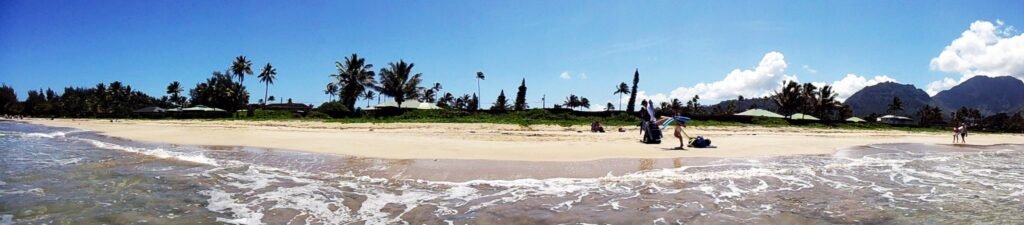
Featured photograph: Hanalei Bay, photographed in 2012. Cymru.lass / Wikimedia Commons, CC BY-SA 3.0. Cropped for display; image adaptations retain the same license.
